


Scientific & Practical Journal


Editorial News
Dear Readers! We are pleased to present the tenth issue of Logistics journal for 2026. The materials in this issue cover a wide range of current topics in logistics science and practice.
Dear readers, we are pleased to present the ninth issue of the journal “LOGISTICS” for 2026. The issue features articles that not only reflect current industry trends but also provide practical guidance for managerial decision‑making.
Dear readers! You are holding the combined issue of the “LOGISTICS” journal, in which we have collected materials for July and August 2026. It brings together practice and theory, applied solutions and bold methodological explorations.
PHOTO OF THE WEEK

CITATIONS
 |
 |
 |
 |
 |
 |
 |
 |
 |
 |
«Logistics» Journal № 10 / 2026
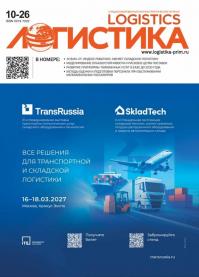
WAREHOUSE. INVENTORY MANAGEMENT
«Cubic» from «Yandex Robotics»: how the subscription service is changing warehouse logistics
TRANSPORT. TRANSPORTATION
Transportation of coal and containers in rolling stock of various types
Annotation. The article deals with the history of the issue of transporting large-capacity containers in open wagons. The operational and economic aspects of removing administrative restrictions on the implementation of this type of transportation are considered. Solutions are proposed to create a healthy competitive environment in the container transportation segment of the transport services market.
Key words. Container, gondola car, fitting, platform, economy, terminal, railway.
SUPPLY CHAIN MANAGEMENT
Model of integrated management of container flows in a regional terminal network
Annotation. The paper addresses the problem of integrated management of container flows in a regional terminal network. A graph-analytical model is proposed that takes into account three variants of the delivery chain, the handling and throughput capacities of terminals and network sections, as well as the route consolidation effect arising when the target traffic volume is reached. Using actual data, the assignment of outbound and inbound container flows to terminals is optimized. A reduction in total costs is shown for both outbound and inbound traffic. The feasibility of specializing terminals by traffic direction and of transitioning to a macro-regional terminal network is substantiated.
Key words. Container transportation, terminal network, container flow, route consolidation, optimization, terminal specialization, macro-region.
Annotation. The article proposes a shift from subjective expert assessments to the empirical calibration of supply chain resilience models. Based on the management accounting data of a motor transport enterprise, the Quantitative Supply Chain Resilience (QSCR) model and the 4C-based integral risk index are parameterized. It is shown that fleet renewal at a single link enhances the resilience of the entire supply chain, while maintenance standards underestimate the costs of stochastic failures. With monthly aggregation, no link between resilience and costs is found; trip-level accounting is substantiated.
Key words. Supply chain management, resilience, 4C concept, QSCR model, Markov processes, failure rate, empirical calibration, risk management.
INDUSTRIAL LOGISTICS
Methodology for selecting rational technological routes for heating cast billets in rail and bar production as a tool for improving production logistics
Annotation. The article presents a method for selecting rational technological routes for heating cast billets, based on the construction of situational tactical models and the assessment of cost. The approach considered allows not only to ensure the uninterrupted operation of the rail-and-beam production during the reconstruction period, but also serves as an example of the effective application of production logistics tools to reduce the cost of production.
Key words. Production logistics, technological routes, rail-beam shop, cycle models, cost optimization.
EDUCATION. PERSONNEL
Development of methods for assessing and training personnel serving passengers with reduced mobility a case study of railway stations in Southern Russia
Annotation. The article examines issues regarding staff training and the enhancement of customer-oriented service for passengers with limited mobility at railway stations. It notes a steady increase in passenger traffic within this category, necessitating the adaptation of both infrastructure and service protocols. The study analyzes the primary challenges faced by people with limited mobility, including those stemming from the human factor. A four-level staff competency model is proposed, and a methodology for assessing customer orientation using weighting coefficients is developed. It is demonstrated that combining specialized training with financial incentives significantly improves the quality of transport services provided.
Key words. Rail transport, people with limited mobility, personnel training, customer orientation, training effectiveness assessment.
CUSTOM HOUSE
Current state and trends of customs control over fissile and radioactive materials in the Russian Federation
Annotation. The article analyzes customs control indicators for fissile and radioactive materials in the Russian Federation for the period 2021–2025, based on data from the Federal Customs Service of Russia, and compares them with international statistics from the IAEA. Issues regarding staffing and technical equipment at specific road border crossing points are highlighted, as is the insufficient provision of stationary detection systems for fissile and radioactive materials at a number of these facilities. The article substantiates the need to establish a research and educational center dedicated to the customs control of fissile and radioactive materials in order to address staffing and scientific challenges in this field.
Key words. Customs affairs, technical means of customs control, fissile and radioactive materials, customs checkpoints, specialist training, radiation safety.
Annotation. The study focuses on the development of the customs services platform up to 2030, taking into account strategic documents of the Eurasian Economic Union, initiatives of the Eurasian Economic Commission, and the digital transformation program of the Federal Customs Service of Russia for 2022–2025. Three stages of development are presented, and their key implementation indicators are compared with the indicators of leading practices in customs administration. Promising approaches to developing the field of predictive customs administration are proposed.
Key words. Customs service, digital transformation, roadmap, customs administration, digital twin, customs monitoring, import-independent technologies.
PROBLEMS AND OPINIONS
Comparative analysis of methods for determining weighting coefficients in the integral assessment of logistics process efficiency
Annotation. The article studies methods for determining weighting coefficients in the integral assessment of logistics process efficiency. The methods are analyzed, along with their data requirements, labor intensity, and transparency. Methodological recommendations for selecting methods are presented.
Key words. Weighting coefficients, integral assessment, logistics processes, Analytic Hierarchy Process, entropy method, Principal Component Analysis, criteria weighting method.
Address: 125581, Moscow, Leningradskiy avenue, 63,
floor 6, office 1
Phone: +7 (495) 788-16-96
Е-mail: sales@mg-agency.com
 |
 |
Total or partial reproduction of materials in any way
is allowed only with the written permission of the Publisher
Website developed by
alexeydoronin.com
